
Every business that grows online has one thing in common: a documented digital marketing strategy. Not a loose collection of tactics, not a vendor-managed campaign a deliberate, data-informed plan that connects every channel, every dollar, and every piece of content to a measurable business outcome.
This guide walks you through exactly what digital marketing strategy development means in 2025, the step-by-step process for building one from scratch, and the advanced techniques including AI optimization and GEO/AEO that separate market leaders from everyone else.
Part 1 Foundations #
Section 1: What Is Digital Marketing Strategy Development? #
Digital marketing strategy development is the structured process of designing, aligning, and operationalizing a plan to attract, engage, and convert customers through online channels. It is not a single document — it is an iterative system that spans research, planning, execution, and continuous optimization.
At its core, a digital marketing strategy answers four questions:
• Who are we trying to reach, and what do they need?
• Which channels and content types will reach them most efficiently?
• What measurable outcomes define success for our business?
• How do we allocate budget and talent to achieve those outcomes?
The word "development" matters. Strategy is not a static PDF that lives in a shared drive. It evolves as markets shift, algorithms update, and customer behavior changes. The organizations that treat strategy as a living system consistently outperform those that revisit it annually at best.
There is also a meaningful distinction between a digital marketing strategy and a digital marketing plan. Strategy defines the "what" and "why" your goals, audience, channels, and competitive positioning. A plan defines the "how" the specific campaigns, timelines, owners, and budgets that execute against the strategy. Both are necessary; confusing the two is one of the most common causes of wasted marketing investment.
Section 2: Why Businesses Need a Documented Digital Marketing Strategy #
Research consistently shows that businesses with a documented marketing strategy are significantly more likely to achieve their goals than those operating without one. The reasons go beyond discipline.
Alignment.
A documented strategy creates a shared reference point across departments. When sales, content, paid media, and leadership all work from the same playbook, campaigns become coherent rather than fragmented. Without documentation, every stakeholder operates on their own assumptions about priorities.
Accountability.
Goals without documentation are wishes. A written strategy transforms vague ambitions "grow our brand" or "get more leads" into specific, measurable commitments. This makes performance reviews honest and course corrections precise.
Efficiency.
Undocumented teams frequently duplicate effort, fund overlapping initiatives, and miss channel synergies. A strategy that explicitly maps channels to funnel stages eliminates redundancy and identifies where investment creates compounding returns.
Resilience.
Markets change. Platforms change. When a strategy is documented, responding to change is an editing exercise adjusting specific assumptions or channel allocations rather than starting from zero. Undocumented strategies dissolve the moment their creator leaves the room.
| Key insight: According to the Content Marketing Institute, marketers with a documented strategy are 3x more likely to report success than those without one and 6x more likely to invest in new channels confidently. |
Section 3: Strategy Frameworks SMART, RACE, and SOSTAC Explained #
No single framework is universally "correct," but understanding the most widely used models gives you a vocabulary for building your own system.
SMART Goals #
SMART is not a marketing framework. It is a goal-setting discipline. Every objective in your strategy should be:
• Specific: "Increase qualified leads" is vague. "Increase MQL volume from organic search by 30%" is specific.
• Measurable: Attach a KPI and a data source to every goal.
• Achievable: Ambitious but grounded in historical performance and available resources.
• Relevant: Connected to a real business outcome, not a vanity metric.
• Time-bound: A deadline creates urgency and enables retrospective analysis.
RACE Framework #
The RACE framework, developed by Smart Insights, maps marketing activity to the customer lifecycle: Reach, Act, Convert, Engage. Its strength is its simplicity it forces you to think about what happens at every stage of the journey, not just acquisition.
| RACE Stage | Focus Area |
| Reach | Build awareness via SEO, paid media, PR, social |
| Act | Drive site interactions: content consumption, lead capture |
| Convert | Turn prospects into customers via nurture, offers, UX |
| Engage | Retain and upsell through email, loyalty, community |
SOSTAC Framework #
SOSTAC (Situation, Objectives, Strategy, Tactics, Actions, Control) is the most comprehensive of the three. Created by PR Smith, it provides a logical sequence from diagnosis to execution to measurement:
• Situation: Where are we now? (SWOT, competitor analysis, customer research)
• Objectives: Where do we want to be? (SMART goals)
• Strategy: How do we get there broadly? (positioning, channel mix)
• Tactics: What specific tools and channels will we use?
• Actions: Who does what, and when?
• Control: How do we measure, report, and iterate?
For most mid-market and enterprise organizations, SOSTAC provides the most rigorous foundation. Smaller teams often benefit from the simplicity of RACE paired with SMART goal-setting.
Part 2 The Development Process #
Section 4: Step 1 Situation Analysis & Competitive Audit #
You cannot navigate to a destination without knowing your starting point. The situation analysis is the diagnostic phase of strategy development, and cutting corners here is the single most common cause of strategic failure.
Internal Assessment #
• Audit all existing digital channels: website, email, social, paid, organic search
• Catalog current content assets and their performance
• Map the current customer journey and identify friction points
• Review historical campaign data to identify what has worked and what has not
• Assess team capabilities, technology stack, and budget constraints
Market & Competitive Analysis #
Your competitive audit should answer: who are your primary organic and paid competitors, what keywords and content topics do they dominate, where are the gaps, and what does their customer experience look like?
• Identify 5–10 direct competitors and 5–10 content/search competitors (they may differ)
• Use SEO tools to benchmark domain authority, organic traffic, and top-ranking content
• Map competitor positioning: pricing, messaging, target segments
• Identify content topics where competitors rank but produce thin or outdated content your opportunity
| 💡 Pro tip: A SWOT analysis is useful here, but avoid the trap of making it abstract. Every strength, weakness, opportunity, and threat should be tied to a specific data point or observable market condition. |
Section 5: Step 2 Define Goals, Objectives & KPIs #
Once you understand where you are, you can define where you are going. This step transforms business ambitions into measurable marketing commitments.
Start with business goals revenue targets, market share, product launch timelines and work backward to determine what marketing must deliver to enable those outcomes. This ensures marketing is not operating in isolation.
Tiered KPI Architecture #
The most effective strategies operate on three tiers of metrics:
• Business KPIs: Revenue contribution, customer acquisition cost (CAC), customer lifetime value (LTV), return on ad spend (ROAS)
• Channel KPIs: Organic traffic, conversion rate by channel, email open and click rates, paid media CPL
• Activity KPIs: Content published, keyword rankings achieved, campaign launch cadence
Activity KPIs should never be the primary measure of success they are leading indicators. A team that publishes 50 blog posts per quarter but generates no qualified leads has confused activity with output.
Section 6: Step 3 Audience Research & Buyer Personas #
Digital marketing is only as effective as its targeting. Audience research is where many strategies become generic teams build personas from assumptions rather than evidence and end up speaking to a customer that does not exist.
Primary Research Methods #
• Customer interviews (10–15 interviews is often sufficient to identify patterns)
• Survey existing customers about purchase triggers, channel preferences, and content consumption
• Sales team debriefs: what questions do prospects ask most? What objections appear repeatedly?
• Support ticket analysis: what problems do customers report that your marketing could address earlier?
Secondary Research Methods #
• Keyword research to understand search intent at each funnel stage
• Social listening to identify language, pain points, and community discussion
• Review mining (G2, Capterra, Amazon, Trustpilot) for voice-of-customer language
• Industry reports and analyst research to understand segment trends
A robust buyer persona includes: demographic profile, professional context (for B2B), primary goals and challenges, preferred content formats and channels, key objections to purchase, and trigger events that initiate the buying process.
Section 7: Step 4 Channel Selection & Mix Strategy #
One of the most expensive mistakes in digital marketing is spreading budget across every available channel. Effective channel selection is about identifying where your audience actually spends time, where competitors are weak, and where your team has the capability to execute.
Channel Selection Criteria #
| Criterion | Question to Answer |
| Audience presence | Is your ICP actively using this channel? |
| Competitive intensity | Can you realistically compete for attention or rank? |
| Commercial intent | Does channel traffic convert, or is it awareness-only? |
| Cost efficiency | What is the expected CPL or CAC relative to alternatives? |
| Team capability | Do you have the skills and tools to execute well here? |
| Time to results | Does this channel deliver short-term or long-term returns? |
The Channel Mix Principle #
Effective strategies typically combine:
• Short-term performance channels (paid search, paid social) that generate leads now
• Long-term compounding channels (SEO, content marketing, email) that reduce cost of acquisition over time
• Relationship channels (community, events, influencer) that build trust and referral velocity
The ratio between these depends on your business stage. Early-stage companies often over-invest in performance channels out of urgency; mature companies often under-invest in compounding channels because the returns are not immediate.
Section 8: Step 5 Budget Allocation & Industry Benchmarks #
Budget allocation is where strategy meets reality. There is no universal formula, but the following benchmarks provide a useful starting framework.
Industry Benchmarks for Marketing Spend #
| Industry | Typical Marketing Budget |
| B2B SaaS | 15–25% of ARR on marketing |
| B2B Services | 8–15% of revenue on marketing |
| B2C E-commerce | 10–20% of revenue, higher in growth phase |
| Regulated sectors | 5–10% of revenue (financial, healthcare) |
Allocating Within the Budget #
A common allocation model for digital marketing budgets:
• ~40% — Paid media (search, social, display, retargeting)
• ~25% — Content and SEO (creation, optimization, link building)
• ~15% — Technology and tools (CRM, marketing automation, analytics)
• ~10% — Conversion optimization and UX
• ~10% — Experimentation and new channel testing
| Note: The "right" allocation is the one that maximizes return in your specific competitive context. These benchmarks are starting points, not prescriptions. Adjust based on your situation analysis findings. |
Zero-Based vs. Incremental Budgeting #
Incremental budgeting adjusting last year's budget by a percentage is the norm in most organizations. It is also one of the main reasons marketing budgets remain misallocated over time. Zero-based budgeting, where every line item must be justified from scratch, is more work but often surfaces significant reallocation opportunities.
Section 9: Step 6 Content Strategy & Editorial Planning #
Content is the execution layer of digital marketing. It is how your strategy becomes tangible how you attract organic search traffic, nurture leads, build authority, and retain customers.
Content Pillars #
Organize your content around 3–5 core topic pillars that map to your audience's primary problems and your product or service's key value propositions. Each pillar should have:
• A cornerstone piece (comprehensive guide or pillar page)
• Supporting cluster content (specific subtopics that link back to the pillar)
• Repurposed formats (video, infographic, email, social snippets derived from core content)
The Content Funnel #
• Top of funnel (awareness): Educational content addressing broad pain points blog posts, guides, videos, podcasts
• Middle of funnel (consideration): Comparative content, case studies, webinars, detailed how-to guides
• Bottom of funnel (decision): Product demos, ROI calculators, testimonials, free trials, consultations
Editorial Planning Essentials #
A functional editorial calendar tracks: content topic, target keyword, content format, assigned owner, publication date, distribution channels, and promotion plan. The promotion plan is consistently overlooked publish-and-pray is not a content strategy.
Section 10: Step 7 Measurement, Reporting & Iteration #
A strategy without a measurement framework is a hypothesis. The final step of the development process is establishing how you will know if the strategy is working, at what cadence you will review performance, and how you will course-correct.
Building Your Analytics Stack #
• Web analytics: Google Analytics 4 (GA4) for behavior and conversion data
• Search performance: Google Search Console for organic visibility and click data
• SEO monitoring: rank tracking and backlink monitoring via dedicated tools
• CRM integration: connect marketing data to pipeline and revenue outcomes
• Attribution modeling: determine how credit is assigned across touchpoints
Reporting Cadence #
| Cadence | Focus |
| Weekly | Channel-level performance, spend pacing, anomaly flagging |
| Monthly | Full KPI review against targets, content performance, campaign analysis |
| Quarterly | Strategic review: goal attainment, budget reallocation, channel assessment |
| Annual | Full strategy audit and redevelopment cycle |
The Iteration Mindset #
Performance data should trigger action, not just observation. Establish clear thresholds. if a channel's CPL exceeds a set ceiling for two consecutive months, that triggers a defined review and decision process. This transforms reporting from a backwards looking exercise into a forward-looking management tool.
Part 3 Advanced Topics #
Section 11: B2B vs. B2C Digital Marketing Strategy Key Differences #
B2B and B2C strategies share the same foundational process, but differ substantially in audience behavior, decision dynamics, and channel priorities.
| Dimension | B2B | B2C |
| Decision-maker | Committee of 3–10 stakeholders | Individual or household |
| Sales cycle | Weeks to months | Hours to days |
| Primary intent | ROI, risk reduction, integration fit | Desire, convenience, value |
| Top channels | LinkedIn, SEO, email, events | Instagram, TikTok, Google, email |
| Content that works | Case studies, ROI calculators, demos | UGC, reviews, visual content |
| Lead generation | Gated content, webinars, SDR outreach | Direct D2C, e-commerce, retargeting |
The most important B2B-specific consideration is account-based marketing (ABM): targeting specific high-value companies rather than anonymous search traffic. ABM requires deeper coordination between marketing and sales but produces higher-quality pipeline in enterprise segments.
In B2C, the equivalent is segment-level personalization using behavioral data to serve different messaging to different audience cohorts. Both approaches reflect the same underlying principle: mass messaging is becoming less effective as personalization tools become more accessible.
Section 12: AI Tools & Automation in Digital Marketing Strategy Development #
Artificial intelligence is not a marketing channel it is an operational capability that accelerates every phase of strategy development and execution. The organizations gaining the most from AI in 2025 are those that have integrated it systematically, not those experimenting with individual tools.
Where AI Creates Measurable Value in Marketing #
• Research and analysis: AI tools can analyze competitor content, synthesize customer interview transcripts, identify keyword opportunity clusters, and model audience segments faster than any manual process.
• Content creation and optimization: Large language models accelerate first-draft production, content repurposing, and variation testing. The key is human editorial oversight AI generates volume, humans ensure quality and strategic alignment.
• Predictive analytics: Machine learning models can predict customer churn, identify high-intent leads, and forecast campaign performance with greater accuracy than rules-based systems.
• Personalization at scale: AI enables dynamic content personalization serving different messages to different segments without the operational overhead that previously made this cost-prohibitive.
• Campaign automation: Smart bidding, automated ad creative testing, and triggered email sequences reduce manual workload while improving performance consistency.
| Key consideration: AI adoption in marketing requires data quality. AI systems are only as good as the data they are trained on. Before investing in AI tooling, audit the cleanliness, completeness, and accessibility of your first-party data. |
Section 13: GEO & AEO Building Visibility in AI-Generated Search Results #
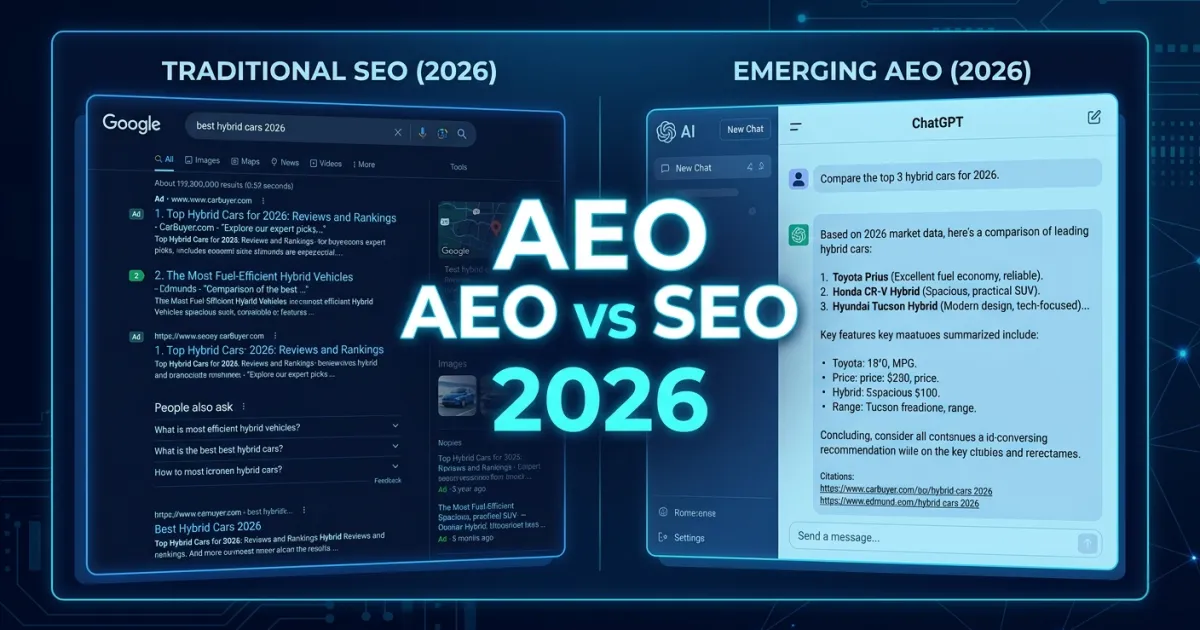
The search landscape is undergoing its most significant transformation since the introduction of Google's PageRank. AI-powered answer engines including Google's AI Overviews, ChatGPT, Perplexity, and Microsoft Copilot are changing how users find information, and the optimization strategies required to appear in these results differ meaningfully from traditional SEO.
GEO: Generative Engine Optimization #
GEO refers to the practice of optimizing content so that generative AI systems select it as a source when synthesizing answers. Unlike traditional SEO, which prioritizes keyword relevance and domain authority, GEO prioritizes:
• Factual density: AI systems favor content that contains verifiable, specific facts, statistics, and citations from authoritative sources.
• Structured clarity: Content that is organized around clear questions and answers is more likely to be parsed and cited by AI systems.
• Entity authority: Being recognized as an authoritative entity within your topic domain through consistent citation, mention, and cross-referencing across the web improves the likelihood of AI citation.
AEO: Answer Engine Optimization #
AEO focuses specifically on featured snippet and direct-answer optimization ensuring that content is formatted to appear as the answer to specific user queries, both in traditional search results and AI-generated responses.
• Structure content around explicit questions in the format the target audience actually uses
• Use clear, concise definitions in the first 50–100 words of any key section
• Implement FAQ schema markup to signal answer-ready content to search engines
• Optimize for "position zero" by providing complete, accurate answers within the page content
| Takeaway: In 2025, effective search strategy requires optimizing for traditional organic rankings, AI-generated overviews, and direct answer formats simultaneously. These are complementary, not competing, objectives. |
Section 14: Common Digital Marketing Strategy Mistakes (and How to Avoid Them) #
• Tactics without strategy: Launching channels because competitors use them, without validating audience fit or setting measurable objectives. Fix: require a one-page channel brief with goals and success criteria before any new channel launch.
• Vanity metrics masquerading as KPIs: Reporting on follower counts, impressions, and page views without connecting them to revenue or pipeline. Fix: audit every metric in your reporting stack and remove anything that cannot be traced to a business outcome.
• Persona fiction: Building audience personas from assumptions and internal meetings rather than actual customer research. Fix: require primary research (interviews, surveys) as a prerequisite for any audience persona document.
• Channel siloes: Managing SEO, paid, email, and social as independent functions with no shared goals or communication. Fix: establish a unified campaign brief process and cross-channel performance reviews.
• One-time strategy development: Building a strategy, filing it away, and revisiting it only when something goes badly wrong. Fix: schedule formal quarterly reviews with structured agendas.
• Attribution blind spots: Defaulting to last-click attribution and missing the contribution of upper-funnel channels to conversion. Fix: implement a multi-touch attribution model that reflects actual customer journey complexity.
Section 15: Agency vs. In-House Which Model Is Right for Your Business? #
The build-vs.-buy debate in marketing is never fully resolved the right model depends on your business stage, budget structure, and strategic priorities.
| Factor | Agency | In-House |
| Cost structure | Variable, scales with scope | Fixed, scales with headcount |
| Expertise breadth | Access to specialists across channels | Deep context on your business |
| Speed to capability | Faster for new channels | Slower to hire and onboard |
| Strategic alignment | Requires proactive management | Naturally aligned to company goals |
| Data ownership | Risk of platform lock-in | Full first-party data control |
| Best for | Specific channel execution, overflow | Core strategy, brand voice, audience |
The most effective model for mid-market and enterprise businesses is typically a hybrid: in-house team retaining ownership of strategy, brand, content, and first-party data, with agencies executing specific high-volume functions (paid media management, technical SEO, video production) where specialist skill sets matter.
Avoid the common mistake of delegating strategy to an agency. Agencies are excellent execution partners. They are structurally less well-positioned than in-house teams to hold long-term strategic accountability.
Part 4 Tools, Templates & Next Steps #
Section 16: How to Diagnose a Failing Digital Marketing Strategy #
Not all failing strategies fail loudly. Many organizations continue executing against a broken strategy for months or years, mistaking declining returns for market conditions or seasonality.
Warning Signs of a Failing Strategy #
• Flat or declining organic traffic despite consistent content production
• Rising CPL across paid channels without explanation
• Low lead quality with high volume but poor sales conversion
• Channel cannibalization where paid and organic are competing for the same audience
• No clarity on revenue attribution marketing cannot demonstrate pipeline contribution
• High content output, low engagement content is being produced but not consumed
The Diagnostic Process #
When warning signs appear, the diagnostic process should follow a structured sequence:
1. Audit data integrity confirm tracking is accurate before drawing conclusions
2. Segment performance by channel, audience, and content type to isolate failure points
3. Compare current results against baseline periods and stated targets
4. Assess whether the failure is strategic (wrong goals or channels) or executional (right strategy, poor implementation)
5. Return to the situation analysis phase and update assumptions before rebuilding
Section 17: Digital Marketing Strategy Template Your Starting Framework #
Use the following framework as a starting point for your own strategy document. Customize each section with data and decisions specific to your business.
Strategy Document Structure #
| Section | What to Include |
| Executive Summary | 1-page overview of goals, audience, channels, budget, and success criteria |
| Situation Analysis | SWOT, competitive landscape, channel audit, customer research synthesis |
| Goals & KPIs | Tiered metrics: business, channel, and activity KPIs with targets and timeframes |
| Audience Profiles | 2–4 buyer personas with research-backed attributes and journey maps |
| Channel Strategy | Selected channels with rationale, resource allocation, and quarterly targets |
| Content Strategy | Topic pillars, content formats, editorial calendar framework, distribution plan |
| Budget Allocation | Investment breakdown by channel, function, and quarter |
| Measurement Framework | Analytics stack, reporting cadence, attribution model, review process |
| Risk & Contingency | Identified risks with mitigation plans and decision triggers for course correction |
| Next Step: Download the full editable template (linked in the resource library) to build your strategy document directly from this framework. The template includes pre-built KPI tracking tables, persona worksheets, and a 90-day launch roadmap. |
90-Day Quick-Start Roadmap #
• Days 1–30 (Research & Foundation): Complete situation analysis, competitive audit, and audience research. Define SMART goals and select primary channels.
• Days 31–60 (Planning & Infrastructure): Build editorial calendar, establish analytics stack, configure attribution, and finalize budget allocation.
• Days 61–90 (Launch & Baseline): Launch initial campaigns, publish foundational content, establish reporting cadence, and capture baseline performance data.
Conclusion #
Digital marketing strategy development is not a one-time event. It is a discipline. The organizations that consistently win online are not those with the largest budgets or the most advanced tools. They are those that have built systematic processes for understanding their audience, setting clear goals, selecting the right channels, and iterating based on evidence.
The framework in this guide applies whether you are building your first strategy from scratch, rescuing one that has gone off-track, or pressure-testing an existing plan against the realities of AI-driven search and evolving buyer behavior.
The next step is not to read more it is to open a document and begin. Start with the situation analysis. Everything else follows from knowing where you are.
| Ready to build your strategy? Download the free Digital Marketing Strategy Template above, or contact our team for a tailored strategy workshop for your business. |

Senior Software Engineer @ Blue Orbit Digital Agency
Hamza Aamir
Browse all articles (1)Hamza Aamir is a full-stack software engineer and builder who works across ideas, systems, and execution. He builds products, designs architecture, and turns ideas into scalable applications. He works in web, desktop, and mobile development using HTML, CSS, JavaScript, jQuery, Tailwind CSS, Bootstrap, React, Next.js, Material UI, PHP, Laravel, Node.js, Express.js, MySQL, SQL Server, MongoDB, Flutter, Dart, C#, C++, ASP.NET, and WinUI 3. He connects frontend interfaces with backend systems and builds efficient, scalable databases. He is interested in system design, software architecture, and product thinking, focusing on scalable and maintainable systems. He also explores cybersecurity and ethical penetration testing using Kali Linux to understand vulnerabilities and improve application security. He follows a builder mindset, constantly learning and creating practical, real-world software solutions.