AEO vs SEO: What's the Difference? (Complete 2026 Guide)
Search Engine OptimizationUnderstanding AEO & SEO at a Glance #
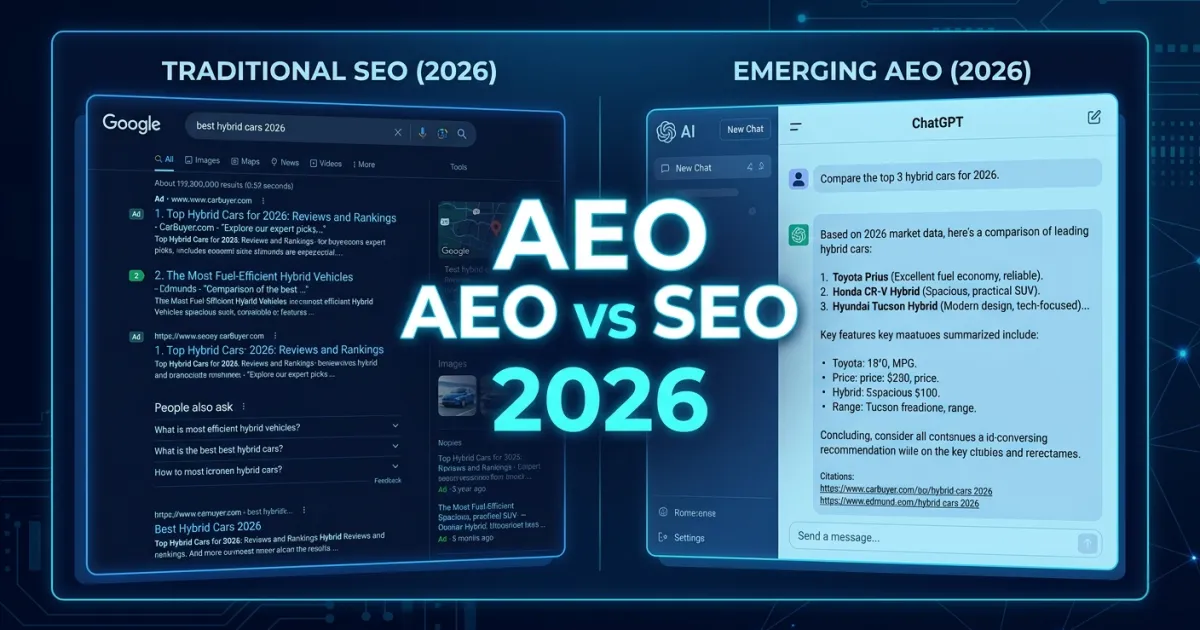
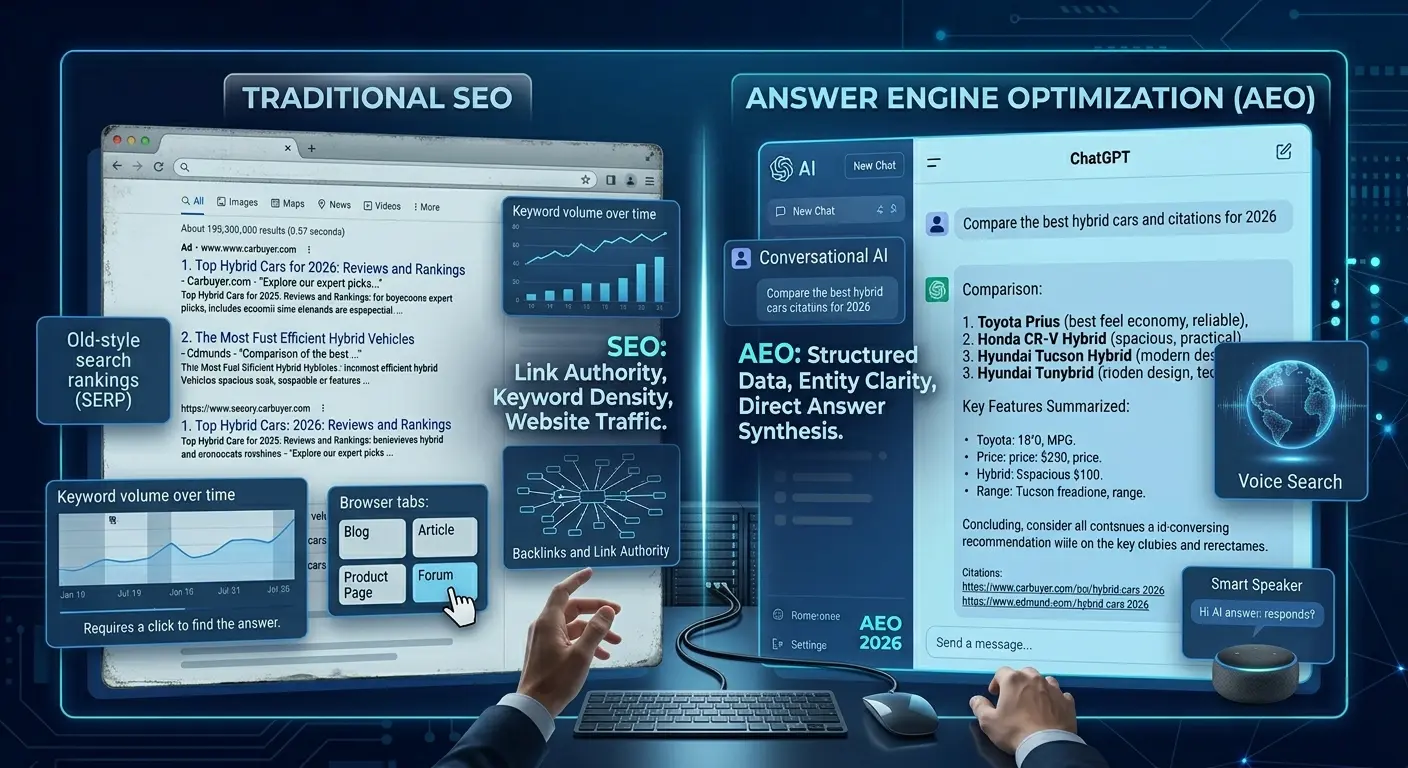
SEO (Search Engine Optimization) helps your website to rank higher on search engines like Google & Bing, so users visit your site by clicking on the results. AEO (Answer Engine Optimization) on the other hand, focuses on getting your content selected as a direct answer by AI driven platforms like ChatGPT, Perplexity AI, and voice assistants. The main difference lies in how users are interacting with your content. SEO brings users to your website through rankings and keywords. AEO directly delivers your content to users in the form of clear and structured answers, that are often without requiring them to click.
These two approaches do not replace eachother at all. Instead, they work together. SEO builds your online presence while AEO increases your chances of being selected as the final and foremost answer. In today’s search environment, especially as AI continues to grow, it is necessary to use both of them.

Why "AEO vs SEO" Matters More Than Ever #
For years, businesses are focused on one clear goal, that is, to rank on the first page of Google. That goal shaped how marketers created content, built backlinks and measured performance.
Now, search behavior has changed.
Today, users usually get answers without even visiting a website. For instance, Google shows AI generated summaries directly in search results. There are platforms like ChatGPT that provide quick and structured responses to detailed questions. Tools like Perplexity AI offer answers along with the sources included. Voice assistants like Siri & Amazon Alexa deliver spoken answers right away.
In all of these cases, users get what they need at once. They mostly do not click on any website even if that site ranks at the top.
This shift explains why AEO is gaining spotlight. A large number of searches now end without a click which means that visibility does not depend on rankings only. Industry forecasts, which includes insights from Gartner, suggest that traditional search traffic will continue to decline in the coming years. The audience is still there but it is moving toward AI generated answer spaces.
If your content does not appear in those answers then users may never see it.
In this guide, you will be able to learn the difference between AEO & SEO in simple terms. We will cover how each works, where they connect, what you should optimize, and how you can construct a content strategy that performs well across search engines and AI platforms.
SEO determines whether you rank. AEO determines whether you're chosen as the answer. In 2026, you need both.
What Is SEO? (Search Engine Optimization) #
Search Engine Optimization (SEO) is a technique of elevating your website so that it ranks higher on search engine result pages (SERPs) like Google, Bing, and Yahoo. The goal is straightforward, that when someone searches for a keyword that is linked to your business, your page appears near the top and attracts clicks.
SEO works through four core areas:
Technical SEO – You make sure that web crawlers can properly crawl and index your site. This includes improving your site speed, mobile usability, structured URLs, and elements like XML sitemaps.
On-page SEO – You optimize individual pages by using clear little tags, meta descriptions, proper headings, internal links, and well-places keywords. You also focus on content quality & relevance.
Off-page SEO – You build your website’s authority through backlinks, brand mentions, and digital PR. When trusted websites link to you, then search engines see your site as more reliable.
Content SEO – You create valuable content such as in depth articles, pillar pages, and topic clusters that match what users are searching for.
SEO success follows a structured path: better rankings lead to more organic traffic, which then leads to conversions. Marketers track this performance by using tools like Google Search Console, Ahrefs, and Semrush. These tools help monitor clicks, impressions, keyword rankings, and overall growth.
SEO still performs a critical role in digital marketing. It is the base ground for your online visibility. Even AEO strategies find it hard to function without strong SEO, because AI systems rely on the same web signals that search engines use to evaluate content.
What Is AEO? (Answer Engine Optimization) #
Answer Engine Optimization (AEO) focuses on structuring content so AI systems can directly pull & present it as an answer to user queries. Instead of waiting for users to click through multiple pages, AEO helps your content to appear inside AI generated responses and answer boxes.
These answer driven surfaces include:
- AI generated summaries in Google results (mostly shown as AI overviews)
- Featured snippets and “People Also Ask” sections
- Responses from tools like ChatGPT, Claude, Gemini, and Perplexity AI
- AI answers in Bing Copilot
- Voice responses from assistants like Siri, Amazon Alexa, and Google Assistant
SEO focuses on ranking for keywords. AEO shifts the focus to a more direct question, that whether an AI system can extract a clear and accurate answer from your content without any efforts.
If a page buries the answer under long introductions or unnecessary detail then AI systems tend to ignore it. They prioritize content that states the answer early, structures it clearly and allows easy extraction.
AEO, at its core, rewards clarity. It pushes content creators to write in a way that machines can understand instantly and users can benefit from immediately.
AEO vs SEO: Side-by-Side Comparison #
Here is the quick comparison most people are searching for. We expand on each row in the next section.
| Dimension | SEO | AEO |
|---|---|---|
| Primary goal | Rank in SERPs and earn the click | Get selected as the answer (often without a click) |
| Discovery surface | Google, Bing, Yahoo blue links | AI Overviews, ChatGPT, Perplexity, voice assistants |
| Content format | Long-form articles, guides, pillar pages | Short, scannable, structured answer blocks |
| Optimization unit | The page | The passage / answer block |
| Key tactics | Keywords, backlinks, technical SEO, content depth | Schema markup, FAQ structure, entity clarity, conversational phrasing |
| Top ranking signals | Backlinks, on-page relevance, E-E-A-T, intent match | Structured data, semantic clarity, source credibility, citability |
| Query length | Short, keyword-style (3–5 words) | Long, conversational, full-sentence questions |
| Measurement | Rankings, organic clicks, impressions, CTR | Citation count, AI mention frequency, share of voice in AI |
| Best for | Driving traffic and conversions on your site | Building brand visibility and trust across AI surfaces |
| Tools | Google Search Console, Ahrefs, Semrush | AI rank trackers, Perplexity dashboards, Ahrefs Brand Radar |

8 Key Differences Between AEO and SEO (Explained) #
1. The Goal Is Different #
SEO keeps a close eye on getting clicks. You rank on search engines like Google, users choose your result & they visit your website. You count success through traffic and conversions.
AEO focuses on visibility inside answers. Users may not visit your website at all. Success means that platforms like ChatGPT mention your brand or your content appears in AI generated summaries. Instead of asking “Did they click?”, you ask “Did they see or hear about us?”
2. Content Structure Works Differently #
SEO appreciates content that is detailed & in-depth. Long-form pages that have strong internal linking and complete topic coverage perform better usually.
AEO rewards clarity and structure. AI systems prefer content that gives a direct answer quickly. Short paragraphs, clear headings, lists, and FAQs make it easier for machines to extract information.
The best approach comes when both are put together. Begin with a clear & direct answer, then expand with detailed content.
3. Optimization Signals Are Not The Same #
SEO relies on established signals like backlinks, keyword usage, technical performance, internal links, and content quality.
AEO put more emphasis on the way how machines read & understand the content. Key factors include:
- Structured data (schema markup like FAQ, Article, or Product)
- Clear and consistent brand and entity mentions
- Presence in knowledge sources such as Wikipedia and Wikidata
- Brand mentions across the web, even without links
- Updated, fact-based content with reliable information
4. Search Queries Are Almost Opposite #
SEO mostly targets short keywords like "best CRM software." AEO targets natural, conversational questions. Users ask complete queries through AI platforms and voice assistants, typically with specific details and intent. This means focusing more on the real questions your audience asks, not just keywords.
SEO mostly targets short keywords like “best CRM software.”
AEO looks at natural & conversational questions. Users ask complete queries through tools such as Google Assistant or AI platforms, typically with specific details & intent.
This means that you need to focus more on the real questions that your audience tends to ask, not just keywords.
5. The User Journey Is Shorter #
In SEO, users follow a longer path: search → results page → click → read → convert. In AEO, the journey often becomes: question → answer → decision. Platforms like Perplexity AI or ChatGPT can provide complete answers instantly. Sometimes users still visit your site, but often they make decisions based on the answer itself.
In SEO, users follow a longer path: search → results page → click → read → convert.
In AEO, the journey often becomes: question → answer → decision. Platforms like Perplexity AI or ChatGPT can provide complete answers instantly.
Sometimes users still visit your site, but often they make decisions based on the answer itself.
6. Measurement Is Still Evolving #
SEO uses well-established tools — Google Search Console, Ahrefs, and Semrush — to track rankings, traffic, and performance. AEO measurement is still developing. Marketers now track how often AI tools mention or cite their brand, visibility across AI-generated answers, presence in key prompts, and brand mentions with or without links. New tools continue to emerge, but the system is still maturing.
SEO utilizes well-established tools like, for instance, Google Search Console, Ahrefs, and Semrush in order to track rankings, traffic, and performance.
AEO measurement is still developing. Marketers now track:
- How often AI tools mention or cite their brand
- Visibility across AI-generated answers
- Presence in key prompts that users ask
- Overall brand mentions, with or without links
New tools and methods continue to emerge, but the system is still growing.
7. Content Distribution Matters More #
SEO gives priority to your website as the final destination. AEO expands focus to your presence across the web. AI systems rely on multiple sources, not only your site. To improve AEO visibility, you need to get featured on trusted third-party platforms, build strong brand references across directories and listings, contribute expert insights on credible websites, and keep business information consistent everywhere.
SEO gives priority to your website as the final destination.
AEO lays eyes on your presence across the web. AI systems rely on multiple sources, not only your site. In order to improve visibility, you need to:
- Get addressed on third-party platforms, which are potentially trusted
- Build rigid brand references across directories & listings
- Contribute to expert insights on websites that are credible
- Maintain business information that is consistent everywhere
The more your brand appears across reliable sources, the more likely the AI systems will trust & include it.
8. Backlinks Still Matter - But Not Alone #
Backlinks remain important for SEO - they signal authority and trust to search engines. In AEO, backlinks still help, but brand mentions also carry strong value. Even without a link, a mention of your brand in relevant content helps AI systems understand your position in the market. In 2026, link-building should be part of a broader strategy that combines backlinks with strong brand visibility and consistent mentions across the web.
Backlinks remain important for SEO. They signal authority & trust to search engines.
In AEO, backlinks still help, but brand mentions also carry strong value. Even without a link, a mention of your brand in relevant content helps AI systems understand your position in the market.
In 2026, you should not rely only on link-building. You should build a broader strategy that combines backlinks with strong brand visibility and consistent mentions across the web.
Where AEO and SEO Overlap #

AEO does not replace SEO. In practice, both depend on many of the same fundamentals. If you are already following strong SEO practices, you are also building a base for AEO. These elements support both strategies:
- High-quality content - Original content that reflects real expertise and offers useful insights or data.
- Strong technical setup -Your site loads fast, works well on mobile, and is easy for search engines to crawl and index.
- Clear structure - Content organized with a logical heading flow (H1, H2, H3) so both users and machines can navigate it easily.
- Internal linking - Connected related pages that show depth and authority on a topic.
- Trust signals (E-E-A-T) - Author details, credible sources, and transparent information build trust with both search engines and AI tools.
- Backlinks - Links earned from reliable, relevant websites.
- Topical coverage - Subjects covered in depth across multiple pages rather than relying on a single article.
- Content updates - Fresh, relevant content maintained over time.
SEO builds the foundation. AEO builds on top of it. Without strong basics, your content will struggle to perform in both search rankings and AI-generated answers.
Is AEO Replacing SEO? #
No, AEO is not replacing SEO. It builds on it. Many people assume AI-driven search will make SEO irrelevant - that is not accurate. Both approaches still play different roles, and you need both to stay visible. Here is why:
- SEO still drives most quantifiable traffic. Even with AI summaries growing on Google, users still click on results for many searches. Informational, commercial, and transactional queries continue to bring visitors to websites through SEO.
- AI tools depend on the same web. Platforms like ChatGPT and Perplexity AI rely on content that is already accessible and trusted online. Without strong SEO fundamentals, these systems are less likely to find, trust, or reference your content.
- AEO captures visibility where clicks drop. As more searches end without clicks, AEO keeps your brand visible inside AI-generated answers. Without it, you miss an entire layer of exposure.
- Some searches still rely fully on SEO. Certain queries - local searches like "plumber near me" or direct queries like "HubSpot login" - depend entirely on traditional search results where SEO remains essential.
How to Optimize for AEO: 7 Actionable Tactics #
These are the actions that help your content appear inside AI-generated answers and get cited by platforms like ChatGPT and Perplexity AI.
Tactic 1 – Start Every Section With a Clear Answer #
Write a direct answer in the first 40–60 words after each heading. Keep it simple and easy to understand. If an AI system can pick up that exact text and use it without editing, your chances of being cited increase significantly. Add examples and explanations after the core answer.
Tactic 2 – Turn Headings Into Questions #
Use headings that exactly align with how people search. Instead of general titles, frame them as questions - for example, "What is the difference between AEO and SEO?" This works better because it reflects real user queries and makes your content easier for AI to match to specific prompts.
Tactic 3 – Define Concepts Early #
When introducing a topic, explain it immediately in one simple sentence. A clear definition at the start makes it easier for AI systems to extract and display your content as a direct answer. Avoid burying definitions under lengthy context.
Tactic 4 – Use Structured Formats #
Break down content into lists, steps, and tables wherever possible. Structured formats make information easier to scan and far easier for AI systems to process compared to long, unbroken paragraphs.
Tactic 5 – Build a Strong Brand Presence #
Make your brand consistent across the web - use the same name, description, and details everywhere. Strengthen your presence on reputable platforms like Wikipedia and other knowledge bases when relevant. Add structured data (like Organization schema) to your website to improve clarity for AI systems.
Tactic 6 – Focus on Mentions, Not Only Links #
Backlinks matter long-term, but brand mentions play a strong role in AEO too. Get featured in industry content, contribute expert insights, and stay active on platforms like LinkedIn. Even when your brand is mentioned without a link, it helps AI systems recognize your authority.
Tactic 7 – Add FAQ Schema and Structured Markup #
Use FAQ schema to define questions and answers on your page in a clear, machine-readable format. This helps both Google and AI tools understand your content better. Pair schema markup with a well-structured FAQ section on key pages.
How to Optimize for SEO: The Foundation Still Matters #
SEO has not become easier with the rise of AEO. The core principles still drive results, and you need to get them right before anything else.
- Match search intent. Identify what the user actually wants before writing. Decide whether the query is informational, navigational, commercial, or transactional - then shape your content accordingly.
- Target the right keywords. Choose keywords based on search volume, competition, and intent. A lower-difficulty keyword with solid volume usually brings better results than a highly competitive one.
- Build topical authority. Create a main pillar page and support it with related articles. Link them together to show depth and expertise instead of publishing disconnected posts.
- Earn quality backlinks. Publish original research, share expert insights, and create resources that naturally attract links from credible websites.
- Strengthen technical SEO. Ensure your site performs well on Google - improve speed, ensure mobile-friendliness, and keep pages easy to crawl and index. Use structured data where needed.
- Update your content regularly. Refresh older content to keep it relevant. Topics evolve quickly, especially in AI and search. Outdated content gradually loses visibility.
5 Common Mistakes to Avoid When Transitioning From SEO to AEO #
Many teams rush into AEO and repeat the same mistakes. If you want real results, avoid these early.
Mistake 1 – Focusing on Quantity Instead of Quality #
Do not try to publish dozens of articles just to keep up. A couple of well-structured, clear, and useful pages perform far better than a large volume of weak, keyword-heavy posts. More content does not guarantee better visibility in AI-generated answers.
Mistake 2 – Relying on Schema Without Strong Content #
Adding FAQ schema alone will not fix poor content. If your page does not answer the question directly and clearly, structured data will not help. Always prioritize writing strong, useful answers first - then support them with schema markup.
Mistake 3 – Ignoring Author Credibility #
Do not publish content without clear authorship. AI systems evaluate trust and expertise. When you add author names, bios, and credentials, you increase content credibility and improve its chances of being selected as an answer.
Mistake 4 – Treating AEO and SEO as Separate Strategies #
AEO and SEO share the same foundational base. Treating them as completely separate wastes time and resources. Instead, build one unified strategy that supports both search rankings and AI visibility simultaneously.
Mistake 5 – Skipping SEO Fundamentals #
Do not ignore the basics. If your website is slow or has poor internal linking, even Google will find it difficult to trust. AI tools depend on those same signals - without solid SEO, your AEO efforts will not succeed.
How to Measure AEO Success vs SEO Success #
SEO performance follows familiar indicators that show how well your website attracts and converts traffic from search engines:
SEO Metrics: What You Already Track #
SEO performance follows familiar indicators that show how well your website attracts and converts traffic from search engines:
| SEO Metric | What It Measures | Tool |
|---|---|---|
| Organic clicks & impressions | How often pages appear and get clicked | Google Search Console |
| Keyword rankings | Where pages rank and how rankings change | Ahrefs, Semrush |
| Conversions & revenue | Business generated from organic traffic | Google Analytics |
| Backlinks & referring domains | Authority and trust your website builds | Ahrefs, Moz |
| Click-through rate (CTR) | How often users choose your result | Google Search Console |
AEO Metrics: What You Need to Add #
AEO shifts the focus from clicks to presence inside AI-generated answers:
| AEO Metric | What It Measures | Tool |
|---|---|---|
| Citation count | How often AI platforms reference your content | Ahrefs Brand Radar, Profound |
| AI share of voice | % of answers in your niche mentioning your brand | Otterly, manual testing |
| Prompt-level visibility | How often content appears for key audience questions | Manual prompt testing |
| Brand mentions | Total mentions across AI platforms, linked or not | Ahrefs Brand Radar |
| AI-driven traffic | Visits coming from chat interfaces and AI tools | Google Analytics (referrer) |
A Real-World Example: AEO and SEO Working Together #
Imagine you run a SaaS company offering project management software for finance teams.
The SEO Side #
You create a detailed page targeting the keyword "project management software for finance teams." You optimize the title, headings, and meta description. You connect it with other relevant pages on your site and earn backlinks from finance and SaaS websites. The goal: rank high on Google, bring users to your site, and convert them into leads or demo requests.
The AEO Side (On the Same Page) #
You start the page with a clear, one-line definition. You compare tools using a clean table. You add a well-structured FAQ section with real questions your audience asks. You use proper schema markup so AI systems can easily understand your content. Beyond your website, you publish expert insights under your leadership team's name on industry platforms and ensure your product gets mentioned in relevant discussions and communities.
What Happens Next #
Your page ranks well on Google and brings in traffic. At the same time, platforms like ChatGPT can pick up your comparison table, and tools like Perplexity AI may link to your content as a source. Voice assistants can even use your short definition to answer queries. One page, one unified strategy - performing across both search engines and AI platforms simultaneously.
The Future: Beyond AEO Lies GEO and AAO #

AEO is only one step in how search is evolving. As AI systems improve, new layers are taking shape. Here is how this space is developing:
- AEO (Answer Engine Optimization) - Focus on getting your content selected as a direct answer. Platforms like ChatGPT or Google pull your content and show it to users instantly.
- GEO (Generative Engine Optimization) - A step further. Instead of just being cited once, your brand becomes part of the overall explanation AI generates. You are not just mentioned - you are included in the broader story around your industry.
- AAO (AI Agent Optimization) - The next layer. AI tools will not just answer questions - they will take action. They may book services, recommend products, or complete tasks for users. For this to work, your data must be structured clearly so AI systems can interact with it, not just read it.
You do not need separate strategies for each new term. These ideas all build on the same core foundation: strong and reliable content, clear structure and formatting, consistent brand presence across the web, and trust signals that demonstrate authority. If you focus on these basics, you are not just improving SEO or AEO - you are preparing your content for whatever comes next.
AI-Immune Keywords: When SEO Still Leads #
AI-driven results are growing rapidly, but they do not dominate every type of search. Some queries still depend on traditional results where SEO performs best. These keyword types mostly remain SEO-focused:
| Keyword Type | Example | Why SEO Leads |
|---|---|---|
| Local service searches | "Plumber near me" | Google maps, listings & local business profiles dominate |
| Navigational searches | "HubSpot login" | Users need a direct link, not an explanation |
| Transactional / shopping queries | "Buy iPhone 16 Pro" | Product listings, ads & shopping carousels replace AI answers |
| Brand-specific searches | "Shopify pricing" | Users expect to find official pages directly |
| Real-time information queries | "NBA score tonight" | Fresh data sources, not AI summaries, are needed |
The key takeaway: do not shift all your focus to AEO. Some keywords still depend fully on SEO. Understanding which is which lets you invest time and effort more effectively across both channels.

Laravel Developer @ Blue Orbit Digital Agency
Syed Zain ul Abidin Ali
Browse all articles (1)I am a passionate web developer and designer with a keen eye for detail and a love for creating visually appealing and user-friendly websites. With a background in graphic design, I enjoy merging the worlds of design and development to build beautiful, functional digital experiences.